
New build homes in Luton need careful plumbing planning around heat pump compatibility, water pressure zoning, pipe material choice, Building Regulations compliance and drainage layout, since developments across areas like Wigmore, Leagrave, Sundon Park, Marsh Farm and Century Park are now built to Future Homes Standard requirements rather than the older gas boiler model most Luton residents grew up with. If you’re buying, self building or renovating a new property in the town, understanding these factors early can save you thousands in retrofit costs and prevent the snagging issues that catch so many new homeowners off guard.
Why Plumbing Planning Matters More in a Growing Town Like Luton
Luton is in the middle of a genuine building boom. Developments such as Pilgrims Chase near Harlington, Castlefield Park and the regeneration schemes clustered around Luton Airport Parkway are adding thousands of new properties to the town’s housing stock. That growth is good news for buyers, but it also means plumbing decisions made at the design stage, long before anyone moves in, will shape how a home performs for decades.
Unlike a Victorian terrace where a plumber can simply adapt existing pipework, a new build starts with a blank canvas. Every valve, manifold and pipe run is a deliberate choice. Get it right and you end up with a home that’s cheap to run, quiet, and easy to maintain. Get it wrong and you’re looking at cold spots, poor pressure, or an expensive first fix correction once plasterboard is already up.
Heat Pumps Are Now the Default, Not the Exception
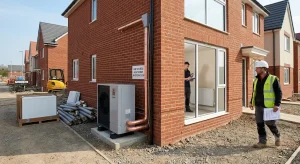
From 2025 onward, gas boilers are no longer permitted in new build homes under the government’s Future Homes Standard. That single change has reshaped first fix plumbing across every new estate in Luton. Air source heat pumps are now the standard heat source in developments like Redrow’s Pilgrims Chase, and they behave very differently to a combi boiler.
Heat pumps run at a lower flow temperature, typically capped around 55°C, which means pipework, radiators and hot water cylinders all need to be sized generously to compensate. Undersized pipe runs or radiators specified for the old gas system simply won’t deliver the same comfort. If you’re specifying or inspecting a new build, ask whether the heating system has been designed specifically around the heat pump’s output, not adapted from an older gas layout.
Water Pressure and Supply Zoning Across Luton
Water pressure in Luton varies noticeably depending on postcode, elevation and how close a property sits to the trunk mains. Homes on higher ground around Wigmore or Stopsley can experience different pressure characteristics compared with properties nearer the town centre or Leagrave. On a new build, this needs to be checked against the manufacturer’s specification for showers, unvented cylinders and any multi outlet bathroom fittings before installation, not after the tiles go up.
It’s also worth confirming with Anglian Water, the regional supplier, whether the development requires a pressure reducing valve or booster set. Developers sometimes fit these as standard on larger schemes, but smaller infill sites or self build plots may need this specified separately.
Choosing the Right Pipework Materials
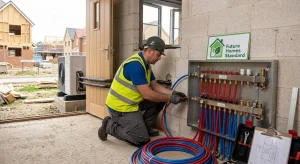
Most new builds in Luton now favour plastic push fit systems over traditional copper for first fix work. Push fit pipework installs faster, resists corrosion, and works well with the manifold based distribution systems that pair naturally with heat pumps and underfloor heating. Copper still has a place, particularly for final connections and areas needing extra durability, but the overall trend on modern estates has shifted firmly toward plastic and composite pipe for the bulk of the system.
Whatever material is chosen, insulation matters just as much. Current regulations require primary circulation pipework, including runs under floors and inside walls, to be properly lagged to prevent heat loss. Builders are now expected to provide photographic evidence of this to building control, so it’s a detail worth asking your developer or plumber about directly.
Building Regulations a New Luton Home Must Satisfy
Plumbing work on any new build in Luton falls under Building Regulations, and several parts are directly relevant:
Part L covers energy efficiency, including hot water system design, insulation standards and heating controls.
Part G governs sanitation, hot water safety and water efficiency, including the requirement that hot water from bathroom taps doesn’t exceed 48°C to reduce scalding risk, while stored water in cylinders must stay above 60°C to control legionella growth.
Part H deals with drainage and waste disposal, covering soil stack placement, gradients and ventilation.
Luton Borough Council’s building control team, or an approved NHBC inspector on larger developments, will need to sign off on this work. If you’re project managing your own build rather than buying from a volume developer, don’t assume your contractor has this covered automatically. Ask for the certification paperwork as the job progresses, not just at completion.
Underfloor Heating and Manifold Design
Underfloor heating has become close to standard on new developments across Bedfordshire, largely because it pairs so well with the lower flow temperatures heat pumps produce. On schemes like Pilgrims Chase, ground floor underfloor heating comes fitted as part of the Eco Electric specification.
The key consideration here is manifold placement. A manifold acts as the central distribution point for the whole underfloor system, and where it sits affects pipe run lengths, future access for maintenance, and how evenly heat spreads across the floor. It should never be an afterthought bolted in wherever there’s spare cupboard space. Good manifold positioning is decided at the same time as the room layout.
Bathroom and Kitchen Layout: Plan the Wet Rooms Together
One of the most overlooked plumbing considerations in new build design is simply where the wet rooms sit relative to each other. Stacking bathrooms vertically, so an en suite sits directly above a ground floor cloakroom, shortens pipe runs, reduces the number of bends in the system and cuts the risk of drainage problems later. The same logic applies to kitchens, which should sit close to the main soil vent pipe wherever the floor plan allows.
If you’re extending or converting in future, roughing in extra supply and waste connections now, even for a bathroom you don’t plan to build immediately, is one of the cheapest future proofing decisions available at the construction stage.
Common Snagging Issues in Brand New Luton Homes
Even professionally built new homes aren’t always snag free. The issues that turn up most often include:
Low water pressure caused by incorrectly sized pipe diameters or a poorly set pressure regulator.
Improperly sealed joints leading to slow leaks that only become obvious weeks after move in.
Fixtures like taps or toilets that were never tested properly before handover.
Sediment or debris left inside pipework from the construction process, which can affect flow and clog fittings soon after the system is switched on.
Poor venting on waste pipes, causing gurgling drains or unpleasant odours.
If you spot any of these in a new home, the first call should go to your developer, since the work should be covered under warranty. But a second opinion from an independent, qualified plumber gives you an honest assessment of whether the fix being offered actually resolves the root cause.
Why It Pays to Bring In a Qualified Plumber in Luton Early
Whether you’re buying off plan, self building on an infill plot, or snagging a home you’ve just moved into, having an experienced, Gas Safe registered plumber in Luton review the specification before pipes go behind the walls is one of the most cost effective decisions you can make. A local plumber who understands the town’s water pressure patterns, the common layouts used by developers like Redrow, Crest Nicholson and Taylor Wimpey, and the specific requirements Luton Borough Council’s building control team look for, can flag problems while they’re still cheap to fix.
Frequently Asked Questions
Do new build homes in Luton still use gas boilers?
No. New build homes across Luton built from 2025 onward are required to use low carbon heating, typically air source heat pumps, instead of gas boilers under the Future Homes Standard.
What water temperature is legally required in a new build bathroom?
Hot water from basin taps must not exceed 48°C to prevent scalding, while water stored in cylinders must be kept above 60°C to prevent legionella bacteria.
Is underfloor heating standard in new Luton developments?
It’s increasingly common, particularly on ground floors, because it operates efficiently at the lower flow temperatures heat pumps produce.
Who checks plumbing compliance on a new build in Luton?
Luton Borough Council’s building control department, or an NHBC inspector on registered developments, verifies that plumbing and heating installations meet current Building Regulations.
Should I get an independent plumber to check a new build before moving in?
Yes. An independent plumber in Luton can review pressure, pipe sizing, insulation and drainage before snagging becomes a bigger and more expensive problem.